Family Discovers 8 Huge Dinosaur Footprints..

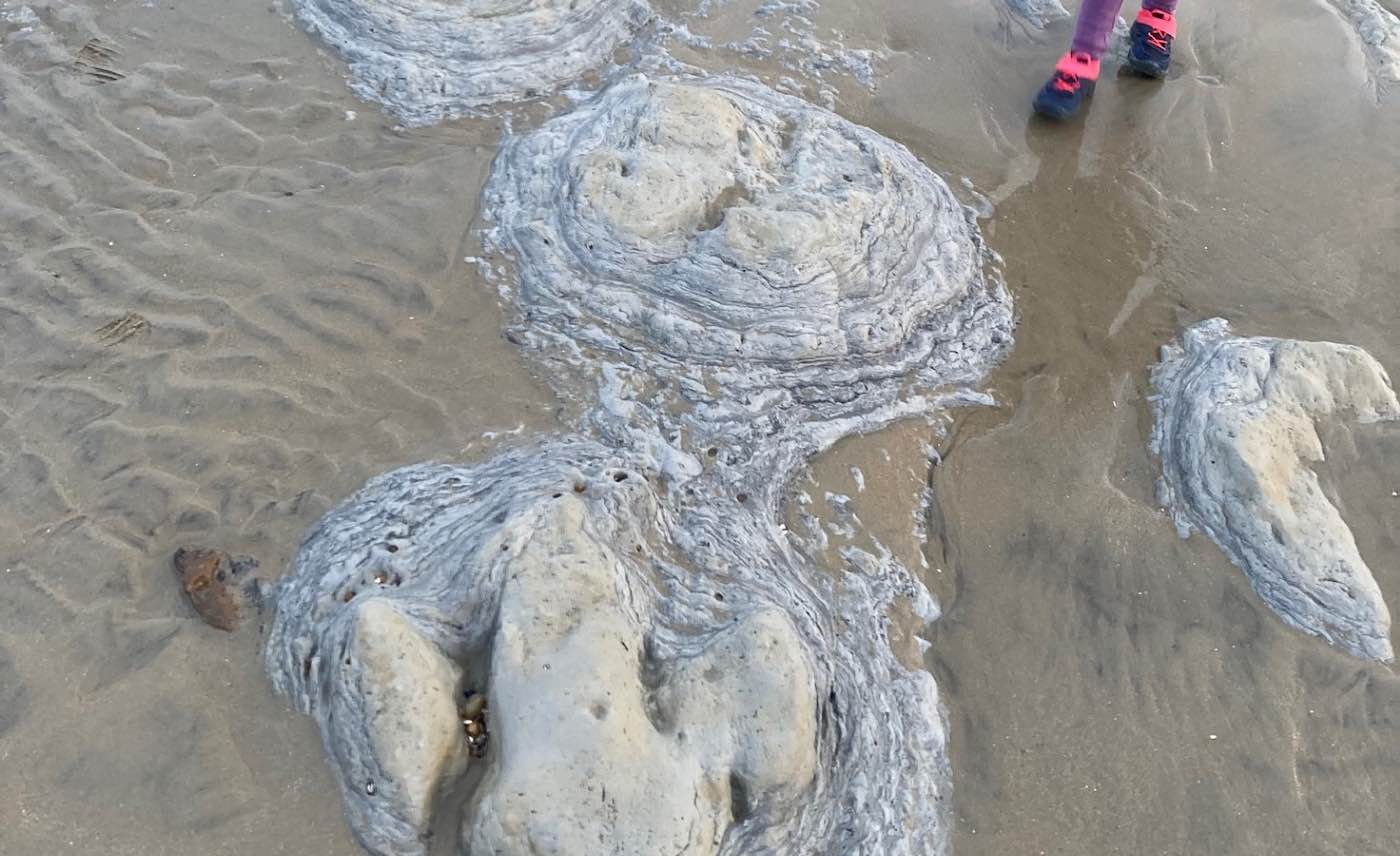
Dinosaur footprints on the beach in Bexhill, East Sussex – By Vicky Ballinger / SWNS
Family Discovers 8 Huge Dinosaur Footprints While Walking on Eroded Beach (Photos): A family was strolling along an eroded beach at sunset when they discovered a trove of eight huge dinosaur footprints Vicky Ballinger and her two kids were stunned by the sight in East Sussex, England, after high tides and heavy rains had worn away the sand, exposing the rock underneath. The area from Bexhill-on-Sea to Fairlight has become known for its track casts and prints of dinosaurs. “I grew up in Bexhill and I’ve never seen these ones before,” says Vicky. “I believe they are iguanodon footprints. They’re not T-rex tracks (because) they weren’t in England.” Vicky went to the local Bexhill Museum with her discovery, and they’re investigating further this week. She also uploaded her video to YouTube (see below). “The kids loved that they could see the track of a dinosaur and walk where it walked. It was very exciting.”

Set of eight Dinosaur footprints on the beach in Bexhill, East Sussex – By Vicky Ballinger / SWNS
In 2018, more than 85 footprints from the Cretaceous period made up of at least seven different species were uncovered by the cliffs between Hastings and Fairlight—including the fine detail of skin and scales. Another fossil discovered on Bexhill beach was confirmed as a ‘pickled’ dinosaur brain. The Bexhill site dates back to around 140 million years ago and contains the remains of dinosaurs that used to roam in the freshwater surroundings of the period. “It’s quite beautiful to find these amazing dinosaur footprints when we came on a walk.” Over the years, the fossils of several dinosaur species have been found including Iguanodon, Megalosaurus, Baryonyx, Polacanthus, and the tooth of a Velociraptor-type animal, many of which are on display at the Bexhill Museum.Check out her lovely video below…Family Discovers 8 Huge Dinosaur Footprints While Walking on Eroded Beach (Photos)

Website can identify birds from photos

www.eurekalert.com: In a breakthrough for computer vision and for bird watching, researchers and bird enthusiasts have enabled computers to achieve a task that stumps most humans — identifying hundreds of bird species pictured in photos.

  • It’s free: The bird photo identifier, developed by the Visipedia research project in collaboration with the Cornell Lab of Ornithology, is available for free at: AllAboutBirds.org/photoID Results will be presented by researchers from Cornell Tech and the California Institute of Technology at the Computer Vision and Pattern Recognition (CVPR) conference in Boston on June 8, reports eurekalert.com.
  • A growing database: Called Merlin Bird Photo ID, the identifier is capable of recognising 400 of the mostly commonly encountered birds in the United States and Canada. “It gets the bird right in the top three results about 90 per cent of the time, and it’s designed to keep improving the more people use it,” said Jessie Barry at the Cornell Lab of Ornithology. “That’s truly amazing, considering that the computer vision community started working on the challenge of bird identification only a few years ago.” To see if Merlin can identify the bird in your photo, you upload an image and tell Merlin where and when you took it. To orient Merlin, you draw a box around the bird and click on its bill, eye, and tail. Merlin does the rest. Within seconds, it looks at the pixels and combines powerful artificial intelligence techniques with millions of data points from humans, then presents the most likely species, including photos and sounds.
  • The devil’s in the details: Computers can process images much more efficiently than humans — they can organise, index, and match vast constellations of visual information such as the colours of the feathers and shapes of the bill,” said Serge Belongie, a professor of Computer Science at Cornell Tech. “The state-of-the-art in computer vision is rapidly approaching that of human perception, and with a little help from the user, we can close the remaining gap and deliver a surprisingly accurate solution.” Merlin’s success relies on collaboration between computers and humans. The computer learns to recognise each species from tens of thousands of images identified and labeled by bird enthusiasts. It also taps in to more than 70 million sightings recorded by birders in the eBird.org database, narrowing its search to the species found at the location and time of year when the photo was taken.
  • Better with time: Because the photo identifier uses machine learning techniques, it has the potential to improve the more people use it. After it can reliably identify photos taken with smartphones, the team will add it to the Merlin Bird ID app, a free app that has helped users with more than 1 million bird identifications by asking them five questions. Source: The Asian Age, Image: https://flickr.com