
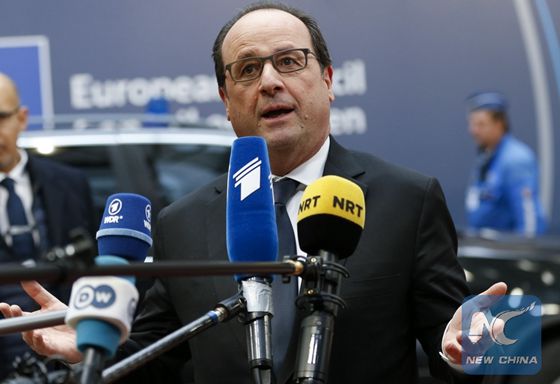
French President Francois Hollande speaks to media upon his arrivals at a two-day European Union summit at EU headquarters in Brussels, Belgium, Feb. 18, 2016. [Photo/Xinhua]
With the next presidential elections slowly but surely approaching, French President Francois Hollande defended his economic and political credentials, saying he was "ready" to face the public's rising discontent and said he was "not afraid" to lose the race to the Elysee Palace. "Is there anyone who can do better? I'm not afraid to lose. I will not get frustrated and I do not blame the French," Hollande told L'Obs magazine. "As the presidential election is getting closer, French voters will be able to compare if I did what I had promised," he added. A recent Elabe poll for the news channel BFMTV showed 88 percent of voters disapprove of their Socialist leader with 72 percent of supporters of Left parties saying they were against Hollande's candidacy in the 2017 election. Hollande asked French people to judge him on his long-term bid to address the country's economic and financial problems. Taking office in 2012, the Socialist president inherited limp growth, a gaping trade deficit, 10 percent unemployment and strained public finances. Five years after, financial troubles were fixed, purchasing power had improved, industrial output gained momentum and economy recovered and started to create jobs, according to Hollande. "It is legitimate that I should be judged on this result," he stressed. Another poll released in September showed that Hollande would lose his bid for re-election in the first round of voting, adding he would garner between 11 and 15 percent of the vote. Haunted by poor public support and dogged by long-running unemployment, Hollande said he would decide whether to seek a second term or not in December. "I'll tirelessly continue to defend the policies I have chosen. I fully assume responsibility. I will not apologize or get rid of it," he noted. French voters handed a considerable win to the far-right party the National Front (FN) in local and European elections last year. FN head Marine Le Pen is almost certain to enter the second round of the presidential election, according to an Elabe survey released last month. Asked whether he will back his Conservative predecessor Nicolas Sarkozy in a hypothetical face-off with Le Pen in a presidential runoff, Hollande said: "If there would be a necessity to vote Sarkozy, we would do so." The two rounds of French presidential elections are set for April 23 and May 7, 2017. Source: China.org.cn
|
I can’t be hypnotising a snake!: Priyanka
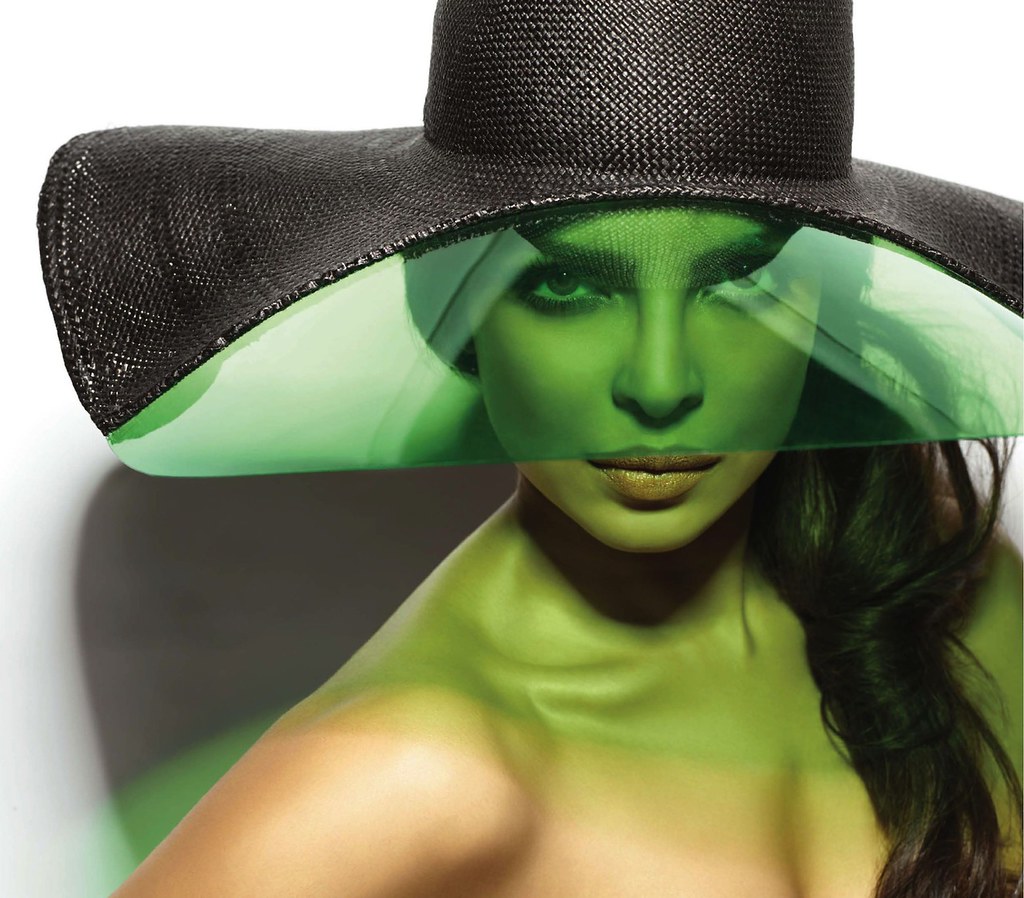
Priyanka Chopra is dead against the way the west stereotypes Indian actors; says she always wanted something that takes her seriously as an actor
|
18 Quotes From Queen Elizabeth II
 . . On Leadership... 
On Grief...
 On Peace... On Peace... Of Relations... Of Relations... On Education... On Education... On the Colonies... On the Colonies... On politics, governance and warfare... On politics, governance and warfare... On seeing and believing... On seeing and believing... On giving birth... On giving birth... On strength... On strength... On what to eat for breakfast... On what to eat for breakfast...  On family life... On family life...   On sincerity to public service... On sincerity to public service... On Christmas... On Christmas...
Queen Elizabeth II has been Queen since 1952 and she's presiding 16 independent countries as their head of state with much gusto. The early part of her reign saw the decline and disintegration of the British Empire and the eventual formation of the Commonwealth of Nations. Her reign was not without trials and even personal setbacks in her family have proven critical to her reign as well. However, with her wisdom, balanced views, and political neutrality seemed to have made her a larger than life figure that's beyond reproach. Her 40th year on the throne was dubbed as "annus horribilis" due to the breakdown of her children's marriage, the burning of Windsor Castle and increased republican sentiments. But she made it through her hardest days and her Golden (2002) and Diamond (2012) Jubilee celebrations was a testimony of the overflowing love and support of her subjects. With a woman of her age and experience, there's no doubt that we could learn something or two from Her Majesty. Her are some of Queen Elizabeth's most popular lines that endure to this. Source: Royal Splendor
|
Maria Crowned Miss Universe 2013
By Rafa Delfin: Venezuela's Maria Gabriela Isler, a 25-year-old accomplished flamenco dancer, was crowned Miss Universe 2013 Saturday night at the Crocus City Hall in Krasnogorsk, Moscow, Russia. Her victory marks Venezuela's seventh Miss Universe crown (1979, 1981, 1986, 1996, 2008, 2009, 2013). Her court includes 1st runner-up Patricia Rodriguez of Spain, 2nd runner-up Constanza Baez of Ecuador, 3rd runner-up Ariella Arida of the Philippines, and 4th runner-up Jakelyne Oliveira of Brazil. Figuring in the top 10 were Yaritza Reyes of the Dominican Republic, Amy Willerton of Great Britain, Manasi Moghe of India, Olga Storozhenko of the Ukraine, and Erin Brady of the USA. Rounding up the top 16 were Jin Ye of China, Fabiana Granados of Costa Rica, Whulandary Herman of Indonesia, Nastassja Bolivar of Nicaragua, Monic Perez of Puerto Rico, and Dominique Rinderknecht of Switzerland. The show was co-hosted by NBC anchorperson and journalist Thomas Roberts and entertainer Mel B (formerly of the Spice Girls). Entertainment was provided by Azerbaijani singer Emin Agalarov, the pop group Panic! At The Disco, and Aerosmith lead singer Steven Tyler, who also served as a judge. Besides Tyler, the other judges were American model and actress Carol Alt, fashion designer Marc Bouwer, Italian watchmaker Italo Fontana, retired American figure skater and Olympic gold medalist Tara Lipinski, Japanese celebrity chef Nobu Matsuhisa, Farouk Systems founder Farouk Shami, and Russian model AnneVyalitsyna. A total of 86 countries competed in this year's edition. ***Note: the Miss Photogenic Universe award was won by Poland's Paulina Krupinska and the Miss Congeniality Universe went to China's Jin Ye. However, the awards were not distributed during the telecast to give way to Steven

The Top Five
Tyler's performance. My thoughts: For the first time since 1973, the pageant was not shown live on American soil, which distressed many pageant fans on the Eastern seaboard of the United States who are used to watching the telecast live. The live telecast from Moscow started promptly at 10 PM Moscow time, which would have been 1:00 PM on the U.S. East Coast. To those who did not want to wait for the delayed telecast on NBC at 9:00 PM, they could view the live stream from various independent sites. I happen to be one of those people who couldn't wait for 9 hours for the delayed telecast, so I opted to view the live stream from a Spanish-language TV station. The transmission was rather decent except for the annoying ads, but about 15 minutes towards the end of the show, the connection started to act up and my Internet froze. CB correspondent Hector Joaquin would later explain that the Internet connection at the Crocus City Hall Media Center had been mysteriously severed as soon as the five

The Critical Beauty Media Room (a/k/a my office) -featuring my laptop, my iPad, my PC. My iPhone took this picture!
finalists were announced. My favorite for the crown was Olga Storozhenko of the Ukraine (photo, below). This woman could do no wrong. I had never seen any unflattering pictures of her from the moment she arrived in Moscow until the finals. Her Hollywood goddess face, her regal and polished bearing, her sultry voice, her perfectly well-toned soft body - I was really hoping that the Ukraine would have its first Miss Universe crown after having sent so many strong and beautiful girls in previous years. But the more I analyzed her images and videos - and her performance in the preliminaries - it dawned on me that she would be just too perfect or "aristocratic" to be Miss Universe. I couldn't imagine her "getting down and dirty" or being surrounded by
 underprivileged children or sick people. Some fans perceived her as icy cold, with which I disagree, especially after having seen her quirky side in the video interview. I didn't have any other favorites after the prelims, but when Olga was shut out of the Top 5, I found myself cheering and rooting for Miss Spain Patricia Rodriguez, whom I thought was the most facially beautiful. But she lacked energy and was less radiant than the others. Avid fans now realize that girls who had competed previously in Miss World, like Patricia, will never win Miss Universe as long as Donald Trump runs the pageant. Ada Aimee de la Cruz of the Dominican Republic (who was 1st runner-up in Miss Universe 2009), had competed in Miss World 2007. Yendi Phillips of Jamaica (who was 1st runner-up in Miss Universe 2010) was a Top 16 semifinalist in Miss World 2007. Gabrielle Walcott of Trinidad & Tobago (who was 2nd runner-up in Miss World 2008), did not even place in Miss Universe 2011. Three girls who competed in Miss World 2013 - Russia, South Africa and Namibia - were all shut out in Miss Universe 2013. Trump realizes the importance of protecting the Miss Universe brand, so any reference to Miss World would simply diminish the prestige of his brand. Take note of that, national directors! Back to the top five assessment. Miss Brazil Jakelyne Oliveira made the cut because she had the best swimsuit body (she's your typical tanned, sexy Brazilian beach garota) but I found her face a little odd (maybe it's her pug nose). Miss Ecuador Constanza Baez was off my radar until she wowed me in the swimsuit competition, but she's a regular butterface and her mint-colored frilly gown didn't do justice to her fabulous figure. She would also fix her hair once in a while, which annoyed me. Miss Philippines Ariella Arida - who won the 16th semifinal stop via online voting - had the most beautiful hair, so silky and bouncy, but her bright sunny yellow strapless gown was more appropriate for a high school prom (although the color perfectly suited her dusky complexion). Her facial expressions were also bland. Miss Venezuela Gabriela Isler gave a strong and consistent performance throughout the entire competition; she was not in my top five list (Spain, Ukraine, Great Britain, USA, Dominican Republic), but she's Miss Venezuela, and that's good enough for the judges to crown her in her iridescent silver gown. Like all past Venezuelan representatives, Gabriela emitted an effervescent personality and remarkable stage projection. Though compared to her predecessor, Gabriela's beauty is ordinary. It's easy to get tired of underprivileged children or sick people. Some fans perceived her as icy cold, with which I disagree, especially after having seen her quirky side in the video interview. I didn't have any other favorites after the prelims, but when Olga was shut out of the Top 5, I found myself cheering and rooting for Miss Spain Patricia Rodriguez, whom I thought was the most facially beautiful. But she lacked energy and was less radiant than the others. Avid fans now realize that girls who had competed previously in Miss World, like Patricia, will never win Miss Universe as long as Donald Trump runs the pageant. Ada Aimee de la Cruz of the Dominican Republic (who was 1st runner-up in Miss Universe 2009), had competed in Miss World 2007. Yendi Phillips of Jamaica (who was 1st runner-up in Miss Universe 2010) was a Top 16 semifinalist in Miss World 2007. Gabrielle Walcott of Trinidad & Tobago (who was 2nd runner-up in Miss World 2008), did not even place in Miss Universe 2011. Three girls who competed in Miss World 2013 - Russia, South Africa and Namibia - were all shut out in Miss Universe 2013. Trump realizes the importance of protecting the Miss Universe brand, so any reference to Miss World would simply diminish the prestige of his brand. Take note of that, national directors! Back to the top five assessment. Miss Brazil Jakelyne Oliveira made the cut because she had the best swimsuit body (she's your typical tanned, sexy Brazilian beach garota) but I found her face a little odd (maybe it's her pug nose). Miss Ecuador Constanza Baez was off my radar until she wowed me in the swimsuit competition, but she's a regular butterface and her mint-colored frilly gown didn't do justice to her fabulous figure. She would also fix her hair once in a while, which annoyed me. Miss Philippines Ariella Arida - who won the 16th semifinal stop via online voting - had the most beautiful hair, so silky and bouncy, but her bright sunny yellow strapless gown was more appropriate for a high school prom (although the color perfectly suited her dusky complexion). Her facial expressions were also bland. Miss Venezuela Gabriela Isler gave a strong and consistent performance throughout the entire competition; she was not in my top five list (Spain, Ukraine, Great Britain, USA, Dominican Republic), but she's Miss Venezuela, and that's good enough for the judges to crown her in her iridescent silver gown. Like all past Venezuelan representatives, Gabriela emitted an effervescent personality and remarkable stage projection. Though compared to her predecessor, Gabriela's beauty is ordinary. It's easy to get tired of  looking at her. Other delegates that made an impression on me included Amy Willerton of Great Britain (photo, left). If there is one contestant who epitomized the old Hollywood glamour à la Veronica Lake, it would be Amy. Her top 10 placement is the best one that her country (Great Britain/United Kingdom/England) has ever had since Karen Lesley Moore placed 4th runner-up in 1983 (exactly 30 years ago!). All that hair-tossing, that sexy-strutting and stunning Jessica-Rabbitesque glitzy red dress paid off for this hot Brit. Then we have Miss China Jin Ye, whose slick hairdo and top model strut in swimsuit made her stand out from the rest. Initially, I was underwhelmed by Miss Dominican Republic Yaritza Reyes's performance during the prelims, but she blew me away with her outstanding performance in both swimsuit and evening gown segments of the finals. Remember, this was the same girl who fell into a hole on stage during the Yamamay fashion show two weeks ago; she quickly recovered and brilliantly finished her routine as if nothing had happened. They say that the Q & A segment determines the results. They say that your answer can either make you or break you. That may be true, but not in this year's competition. Four of the finalists (Ecuador, Brazil, Spain, Venezuela) relied on an interpreter. Here's the full transcript: Question for Ecuador from judge Philip Kirkorov : What would happen to the world if we could no longer use the internet? Ecuador: I believe that computers themselves as one of the technologies nowadays. It has its advantages and disadvantages and one of the disadvantages is that we are no longer as close together with our families. I would like to use this moment to tell the teenagers and everybody that we should use the methodology of computers and the Internet in a positive way. It is never too late to start. Let us start right now. Question for Brazil from judge Carol Alt: What is your opinion in places that do not allow women to vote, travel abroad, or drive cars? Brazil: Good evening everybody! In my opinion, we as women achieved our independence through time. Unfortunately, nowadays we still have some problems with our independence as women. But we need to keep our open minds because nowadays we are homemakers, we are out there in the work force. In my country, we have a female president. We are capable of everything. Question for Spain from judge Anne Vyalitsyna: What is the most significant thing we can do to help elect more women to political offices around the world? Spain: I believe in order to select a good woman, she must possess good qualities in order to perform a good job – discipline, knows how to adapt herself, how to respond with her work, her performance and fulfilling her job. Question for Philippines from judge Tara Lipinski: What can be done about the lack of jobs for young people starting their careers around the world? Philippines: For the people who have lack of jobs, I do believe that we people should invest in education and that is my primary advocacy, because we all know that if everyone of us is educated and well aware of what we are looking at her. Other delegates that made an impression on me included Amy Willerton of Great Britain (photo, left). If there is one contestant who epitomized the old Hollywood glamour à la Veronica Lake, it would be Amy. Her top 10 placement is the best one that her country (Great Britain/United Kingdom/England) has ever had since Karen Lesley Moore placed 4th runner-up in 1983 (exactly 30 years ago!). All that hair-tossing, that sexy-strutting and stunning Jessica-Rabbitesque glitzy red dress paid off for this hot Brit. Then we have Miss China Jin Ye, whose slick hairdo and top model strut in swimsuit made her stand out from the rest. Initially, I was underwhelmed by Miss Dominican Republic Yaritza Reyes's performance during the prelims, but she blew me away with her outstanding performance in both swimsuit and evening gown segments of the finals. Remember, this was the same girl who fell into a hole on stage during the Yamamay fashion show two weeks ago; she quickly recovered and brilliantly finished her routine as if nothing had happened. They say that the Q & A segment determines the results. They say that your answer can either make you or break you. That may be true, but not in this year's competition. Four of the finalists (Ecuador, Brazil, Spain, Venezuela) relied on an interpreter. Here's the full transcript: Question for Ecuador from judge Philip Kirkorov : What would happen to the world if we could no longer use the internet? Ecuador: I believe that computers themselves as one of the technologies nowadays. It has its advantages and disadvantages and one of the disadvantages is that we are no longer as close together with our families. I would like to use this moment to tell the teenagers and everybody that we should use the methodology of computers and the Internet in a positive way. It is never too late to start. Let us start right now. Question for Brazil from judge Carol Alt: What is your opinion in places that do not allow women to vote, travel abroad, or drive cars? Brazil: Good evening everybody! In my opinion, we as women achieved our independence through time. Unfortunately, nowadays we still have some problems with our independence as women. But we need to keep our open minds because nowadays we are homemakers, we are out there in the work force. In my country, we have a female president. We are capable of everything. Question for Spain from judge Anne Vyalitsyna: What is the most significant thing we can do to help elect more women to political offices around the world? Spain: I believe in order to select a good woman, she must possess good qualities in order to perform a good job – discipline, knows how to adapt herself, how to respond with her work, her performance and fulfilling her job. Question for Philippines from judge Tara Lipinski: What can be done about the lack of jobs for young people starting their careers around the world? Philippines: For the people who have lack of jobs, I do believe that we people should invest in education and that is my primary advocacy, because we all know that if everyone of us is educated and well aware of what we are 
doing, we could land into jobs and we could land a good career in the future. So education is the primary source and a ticket for a better future. Question for Venezuela from judge Steven Tyler: What is your biggest fear and how do you plan to overcome it? Venezuela: I believe that one may have a lot of fears but nonetheless this is not something negative. I believe we should overcome all our fears and this in turn would make us much stronger. As soon as we overcome our fears and we're sure of ourselves, we can face any challenge. Even though no one stammered or choked, none of the finalists really answered their respective question. Their answers were either safe or general and sometimes poorly delivered, especially that of Spain's. It is this kind of answers that makes potential pageant contestants spend lesser and lesser time practicing with their interviews - falsely assuming that they can still place and win with a safe answer. Did anyone notice that there were only five questions in the bowl? And did anyone notice, too, that the five judges who had been chosen to ask the questions were all highly prominent celebrities? And most importantly, why was the number of judges an even number (8)? What would have happened if there had been a tie, and who would have been obliged to break the tie? Trump himself? Considering that Miss Philippines was the only one to answer in English, this justifies the controversial statement that she expressed during a TV interview in which she had commented that "Latinas can't even speak a sentence in English" - which, by the way, was taken out of context. Expect Latinas to rely on interpreters next year, and the following year... infinity. To those of you who did not see the live stream on the Internet, you missed the part when Gabriela did not realize that she had actually won. Even Miss Spain was confused. Watch: NBC edited the delayed telecast by cutting out the "confusing" episode. I really wish they stop announcing the winner first before the 1st runner-up. This avoids confusion, especially between the last two girls standing whose native language is not English. Poor Miss Spain was not given a proper "whisk" (usually the whisker would let her pose for the cameras for a few seconds before being pulled completely aside). Everything felt too rushed. There had been many occasions when the last two girls were from countries that did not speak English and there had never been any confusion. Why? Because they stuck to the pattern of announcing the 1st runner-up first before the winner. You don't need a translator. All the hosts have to do was to announce the name of the country. Perhaps if the hosts had positioned themselves closer to the two girls, then the girls wouldn't have been too confused. I miss former hosts Bob Barber and Bob Goen calling the 1st runner-up first and even pointing at the winner to avoid confusion. Gabriela's crowning moment was messed up by poor stage direction and by the fact that her crown slipped off her head three times. I have to say that the stage is probably the most majestic stage that I have ever seen. And this beautiful picture featuring a replica of the Kremlin is what I'd like for the pageant in Moscow to be remembered for, and not the ugly politics behind it or these eerie Matryoshka dolls (Russian nesting dolls):
 |

Top 10 Extremely Dedicated Researchers

Top 10 Extremely Dedicated Researchers By Isaac Cabe, Listverse, 28 October 2013.
For some people, research means nothing more than completing a short experiment in order to learn something simple. Other people attempt ground-breaking research just for the sake of bringing up a new idea. And then there are the type of people who get way more involved with a project than a normal, or even sane, person would. 10. Dr. Katharine Frank, Stripper

Anthropologist. Katherine Frank, who received her Doctorate in Anthropology from Duke University in 1999, specializes in sex-based research. Many researchers prefer the comforts of a lab when conducting studies, but Dr. Frank took things to a new level and went out into the field to conduct some of hers. There’s a common lie told at strip clubs that some of the dancers are “just trying to pay tuition.” For Frank, it was only partially a lie. For her 2002 book G-Strings & Sympathy, Frank drew from her experiences posing as an exotic dancer at five different strip clubs and her interactions with around 30 regulars. Frank’s goal was to study the complexities behind why men visit strip clubs in the first place, despite knowing that they’re not going to leave with the stripper. Her conclusions were largely that there’s a lot of grey area. Her research showed that while next to nobody would say that his wife, girlfriend, or significant other would approve of their presence at a strip club, the men felt a sense of satisfaction that they could not achieve from their marriages, despite the rules and regulations imposed by strip clubs that prevented them from reaching a sexual climax. Interviews outside of the club revealed varying viewpoints, though each had a similar core belief in monogamy at its base. Dr. Frank seems to conclude that, rather than focus on how strippers can be destructive to our culture of monogamy, we should be spending more time researching how commodified pleasures can actually enhance overall marital satisfaction. 9. Sooyong Park And Siberian Tigers: Sooyong Park grew up in Korea

fascinated by tigers. As there aren’t a ton of Siberian tigers left in the wild, it’s been exceedingly difficult to get any footage of them in their natural habitat, and Park made it his goal to get as close to them as possible. Spending nearly five years with close to zero human contact, Park effectively made himself part of the landscape in order to get the best possible footage. Digging himself a small pit, he made enormous personal sacrifices to stay down there in the freezing Siberian temperatures. Eating just a small packet of precooked rice twice a day (with some preserved almonds every so often as a treat), Park did a lot to minimize his environmental impact. The low quantities of food meant he didn’t need to produce much “waste,” but when he did need to go, he double-sealed it into bags so that his scent never got into a tiger’s nose. The result of his dedication was the honour of being the first man to obtain footage of three generations of Siberian tigers in the wild. 8. Wearing

The Same Jeans For Months: While a student at the University of Alberta, Josh Le decided to make college students everywhere look bad and not wash his jeans for 15 straight months. Working alongside Professor Rachel McQueen, Josh wore the same pair of jeans every single day, and sometimes overnight as well. In order to maintain a good general appearance, he’d wipe food off with napkins and brush dirt away as best he could. If the jeans got too smelly, he found that putting them in the freezer every couple of weeks would eliminate odours. After the 15-month trial ended, the jeans were examined for bacterial levels, washed, and then worn every day for another two weeks. At the end of those two weeks, the bacterial levels were measured again, and discovered to be similar to those found at the end of the 15 months. According to Le and McQueen, a normal person with good hygiene shouldn’t be worried about wearing jeans for multiple days impacting their health.

7. Dr. Allen T. Rutberg And Deer: Dr. Allen Rutberg is a biologist who spent the majority of the ’90s focused on a study of birth control. This wasn’t just any birth control, it was a chemical designed to work remotely on female deer. The first part of the study was spent testing whether it was possible to get the chemical (abbreviated PZP) into a significant population of female deer, and Dr. Rutberg and his team spent nearly five years working on the delivery of PZP to a population. Then, for about another three years, they tracked the does to see how many of them were producing fawns. Sure enough, the number of baby deer was down in the group that got the PZP. Now, Rutberg might have the opportunity to implement the experiment in a real-world setting, as a suburb of New York City is experiencing an extreme deer overpopulation problem. Because hunting in suburban neighbourhoods isn’t smiled upon, Dr. Rutberg’s contraception is being looked at as a good substitute. 6. Timothy Treadwell: Timothy Treadwell was a

nature documentary filmmaker who focused the majority of his adult life on working with Alaskan grizzlies. After college and failing to find work as an actor, Treadwell fell into drug abuse and was in pretty bad shape. But after a visit to Alaska, Treadwell became inspired by a couple of near-death experiences with bears and decided to devote his life to filming them in the wild. Every summer for 13 years, Treadwell would go out and live among the bears, getting exceptionally close to many of them. However, one summer he must have gotten a little too close: He was mauled to death along with his girlfriend. Later examination of footage revealed that Treadwell had likely filmed the bear that killed him weeks before. Though his hours upon hours of bear footage were never released formally, Treadwell did manage to write a book, and some of his original footage was used in Werner Herzog’s documentary about his life. 5. Dian Fossey:

Dian Fossey is widely known as a contemporary of Jane Goodall, and she was no less dedicated. After spending the earlier parts of her career in occupational therapy, Fossey went out and began studying gorillas in the wild. What started as a three-year program escalated into a 20-year labour of love. Fighting, sometimes literally, for the conservation of gorillas and their habitats, Fossey became an important figure both locally and on a global scale. At 182 centimetres (6 ft) tall, she was a physically imposing woman, and was known to forcibly interrogate poachers, going so far as to pierce their genitals with sharp plants. Sadly, in 1985 Fossey was found murdered in her hut. The case has attracted a great deal of speculation, but nobody is totally sure what happened. 4. Wilson

Bentley: Wilson Bentley’s nickname was “Snowflake,” and that was not without reason. Beginning when he was a teenager, Bentley became fascinated with snowflakes. He wanted to be able to capture the uniqueness of each one, but this was a difficult task, as the snowflakes would often melt before they were photographed. Bentley went on to pioneer a photography technique that involved attaching a bellows camera to a microscope so that the snowflakes could be captured before they melted. Throughout the course of his life, Bentley would capture around 5,000 unique prints. He died in 1931 after catching pneumonia in a blizzard. 3. Yuri Struchkov: Yuri Struchkov was a

crystallography expert based in Moscow, who produced much of his work in the latter half of the 20th century. Many people who go through higher education will get a paper published at some point. It’s always the result of hard work and research, and they’re usually a big deal. This is what makes Yuri Struchkov an exceptional researcher. Between 1981 and 1990, Struchkov is listed as an author or co-author on 948 different papers. We’ll help you out with the math - that’s an average of one paper every three to four days. It was estimated in his 1995 obituary that he produced over 2,000 academic papers over the course of his lifetime. After his death, it was theorized that a large part of why he pushed himself so hard to publish was to prove to the Soviet Union that he was in fact too busy to get involved with the Party. 2. Ilya Ivanov: Ilya Ivanov was a pioneer in the field of

artificial insemination, and took his research to a whole new level. Beginning his career with horses, Ivanov was among the first to successfully artificially inseminate a horse. Later on, he extended his work to other farm animals, and then continued to work on developing animals that could work well in the frigid Russian winter environments. His obsession with hybrid animals then took a bizarre turn. After successfully hybridizing a wild horse and a zebra, he spent the latter half of his professional life focusing on human-chimp hybrids, even going so far as to get a volunteer human female (who remained unnamed) who would have served as a surrogate for a baby “human-zee.” Unsurprisingly, Stalin didn’t like this very much, and Ivanov was purged. 1. Ed O. Wilson: Ed O. Wilson is known as the “Ant Man” in

some scientific circles, because he has dedicated such a large portion of his life to some of the world’s smallest creatures. Throughout the course of his career, Wilson has been responsible for an insane amount of the world’s knowledge of ants. Working by himself, he was the first to observe over 300 of the 600 known species of one particular genus of ants. In publishing a book of his observations, he drew over 5,000 unique and original pictures documenting the differences in the ants. Wilson was also a prolific author, who thoroughly researched the social aspect of the life of an ant. Astonishingly, his writings led to accusations of racism and misogyny, even provoking someone to attempt attacking him at a symposium. His mental stability would also come into question when he ordered an entire mangrove island to be tented, gassed, and cleared so that he could observe how an ecosystem would start from scratch. Today, Wilson is a professor emeritus at Harvard and an honorary curator in entomology. [Source: Listverse. Edited.] Source: http://alizul2.blogspot.in/
|