
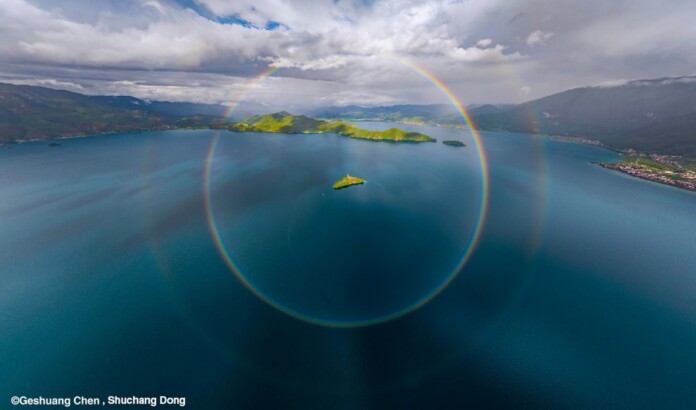
 – credit, Shuchang Dong and Geshuang Chen, entitled “The Glorious Ring.” Winner of Weather Photographer of the Year Contest Shows There’s No End to a Rainbow (LOOK): (O4/11/2025) The Royal Meteorological Society has announced the winners of this year’s Weather Photographer of the Year Competition. Sponsored by the financial services and banking firm Standard Chartered, the competition is now in its 10th year. Chosen from over 4,000 images received from both amateur and professional photographers from 84 countries—the judges’ winners were chosen by an international panel of experts from the fields of weather and climate, photography, and journalism. “A huge congratulations to all our winners and runners-up—the standard of the photographs submitted this year were incredibly high,” stated Professor Liz Bentley, Chief Executive of the Royal Meteorological Society. “The images showcase the weather and climate in its pure beauty and intensity extremely well.” The grand prize winner went to a pair of photographers from China, and their winner of a complete circular rainbow. “It was drizzling on Lugu Lake [In China’s Yunnan Province]. I flew my drone to a height of 500 meters, passed through the rain curtain, with my lens facing away from the Sun, and captured a complete circular rainbow,” says engineer and astronomy photographer Geshuang Chen. Rainbows are a familiar sight, but full-circle rainbows are much less common. From the ground, the lower half of the circle is usually hidden below the horizon. From high above with the Sun behind and rainfall ahead, it’s possible to see the entire circle. Rainbows form when sunlight enters raindrops and is bent (refracted), then reflected off the inside of the droplet, and bent again as it exits. The result is a spectrum of colors forming a circle around the antisolar point: the spot directly opposite the Sun from the viewer’s perspective. Since each observer’s position creates a slightly different angle of light, every rainbow is unique to the person seeing it. That makes this image particularly special: not just a rare view of a complete rainbow, but a moment of perfect alignment, with the small island framed precisely at its center. 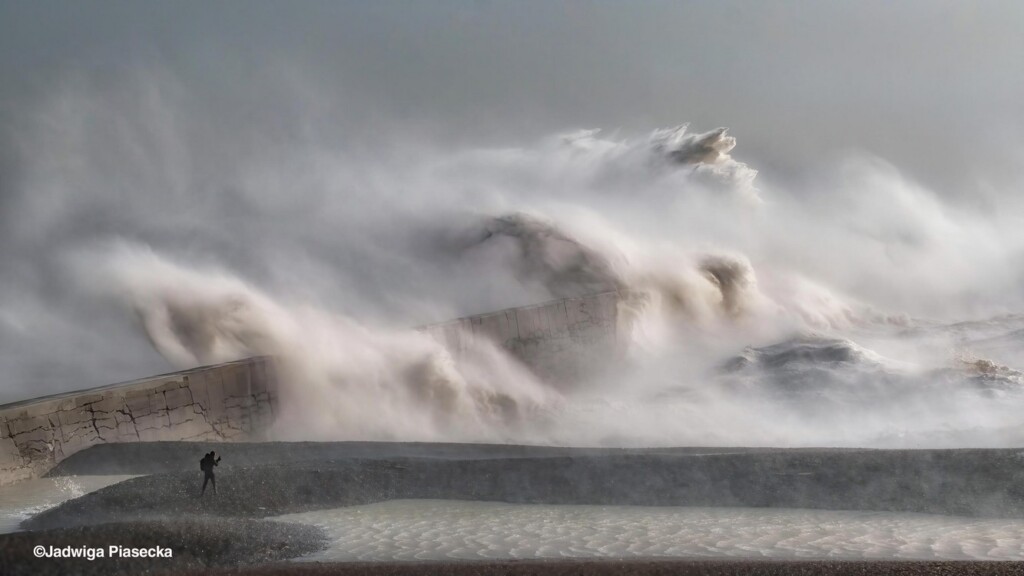 – credit, Jadwiga Piasecka, entitled “Eunice III.” The runner-up in the main category was won by Jadwiga Piasecka, who took this image from a sheltered place out of reach of Storm Eunice in Newhaven, on the south coast of the UK, where winds were gusting at over 80 miles per hour. “From my vantage point, I watched enormous waves battling against the sea wall, sending dramatic sprays of water high into the air… highlighting just how immense the storm’s fury truly was.” “I’ve loved big waves and storms since I was a kid—the power and energy of the sea have always fascinated me. So, when Storm Eunice rolled in, I knew I couldn’t miss the opportunity to witness it firsthand,” she wrote. 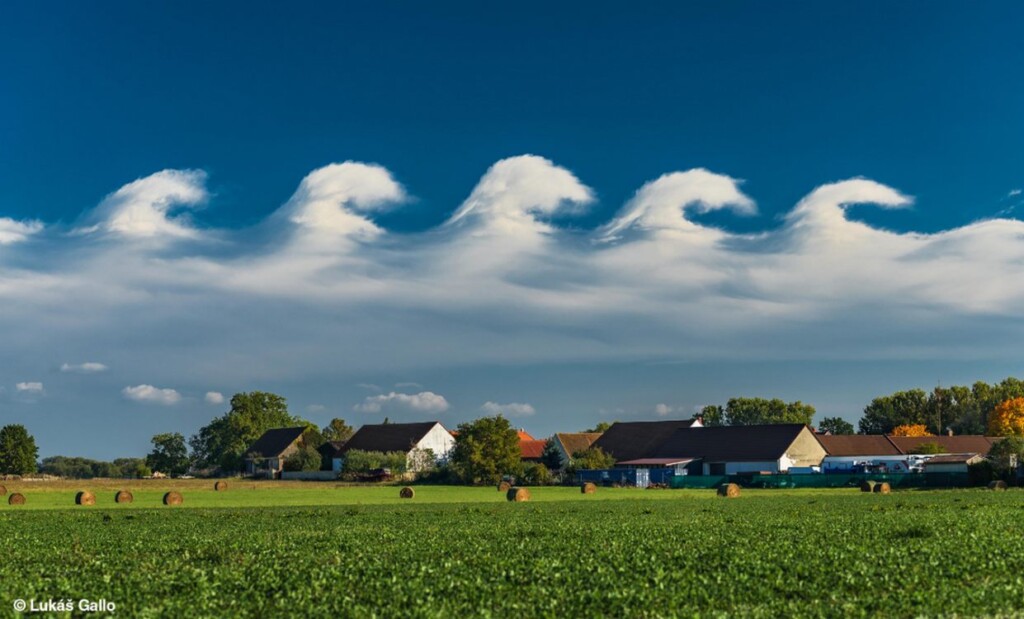 – credit, Lukas Gallo, entitled “Sky Surfing.” While driving near Vodňany in South Bohemia, Czechia, photographer Lukáš Gallo saw a stunning set of Kelvin-Helmholtz wave clouds appear overhead. He quickly pulled over, grabbed his camera, and captured the momentary display from a roadside field that won third place and the public vote. “I didn’t plan this; it was all of a sudden. But I think that’s the best kind of photograph,” he says. These rare ‘wave,’ or fluctus, clouds are formed when there’s a sharp difference in wind speed or direction between two layers of air, similar to the way wind can whip up waves on the surface of the sea. The result is a spectacular series of cloud curls that look like breaking ocean waves, as well as a clear visual warning of turbulence. Set against a peaceful rural landscape with round hay bales dotting green fields, the dramatic waves seem even more extraordinary, like nature briefly showing off above an everyday scene. 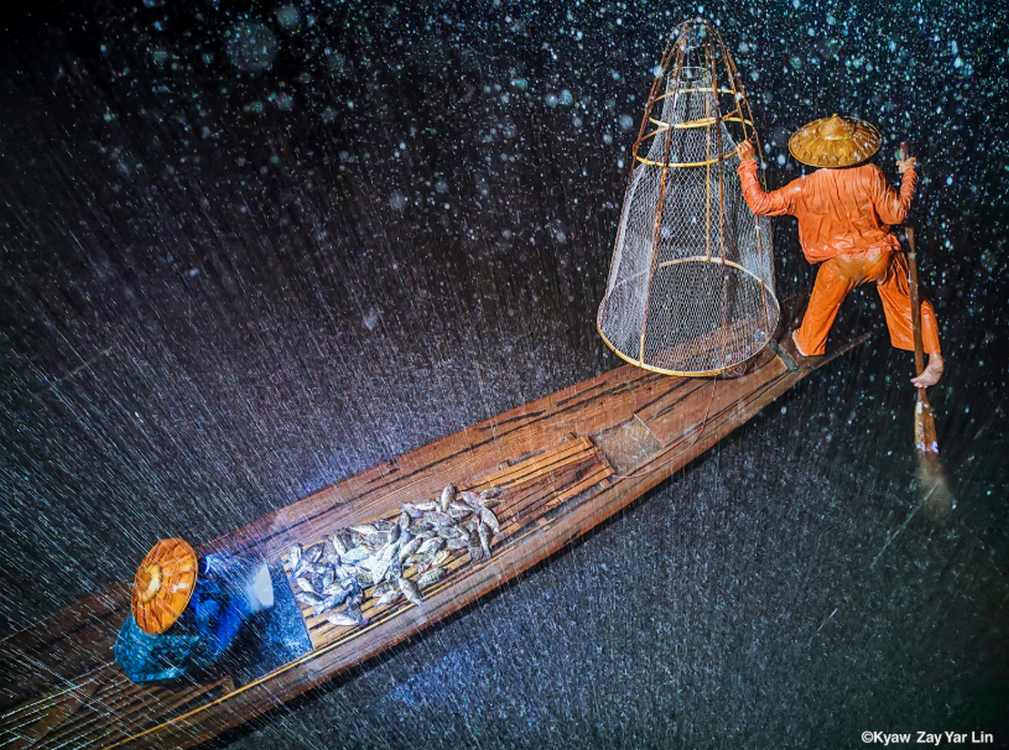 – credit, Kyaw Zay Yar Lin, entitled “Fishing in Raining Season.” The mobile category was won by a photographer traveling to Inle Lake in Myanmar. This photo captures the urgent feeling of being caught in a sudden downpour. Two fishermen work quickly: one paddling through the dark water, the other bailing it out of the boat. Their bright orange and blue clothes stand out vividly, just like the heavy raindrops streaking across the frame.The motion blur of both the fishermen and the rain make the viewer feel part of the action, caught in the sudden intensity of a tropical storm. Raindrops fall in sheets and splash against the murky lake below as water fills the boat’s base. Winner of Weather Photographer of the Year Contest Shows There’s No End to a Rainbow (LOOK) |
2 more sniffer dogs to guard rhino
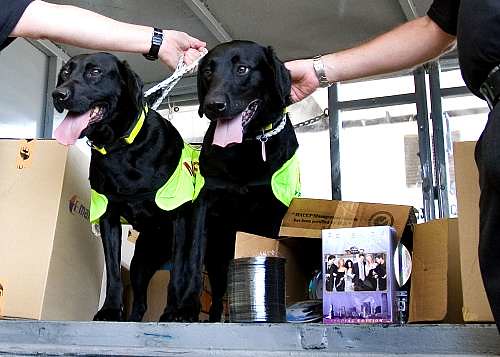
Manoj Anand, Guwahati: Bogged down by poaching threat, the wildlife authorities in Kaziranga National Park have embarked upon ambitious plan of taking help of sniffer dogs — Kareena and Babli to combat poachers who silently enter the park to kill precious one-horn rhinos for its horn. The park authorities had started this experiment with Jorba, the lone sniffer dog deployed to keep a watch on poachers. The success of Jorba in keeping surveillance has encouraged park authorities to induct two more sniffer dogs for Jorba’s company. The head of wildlife trade monitoring network Shekhar Kumar Niraj said that after a month of training in anti-poaching operations, Kareena, a German shepherd and Babli of Belgian Shepherd species have been inducted. He said, “Dogs have proved to be very effective in anti-poaching operations. Our forests need a good number of these canines. They give us very vital clues, even trace poachers or wildlife articles after the crime has been committed.” In fact experiment with canine detective had started way back in 2013 itself in Kaziranga National Park when park authorities imported Jorba from Slovakia with the help of Aranyak, wildlife NGO. Since then the five-year-old dog has led to more than 10 arrests and officials claim its success ratio was more than 60 per cent. The park director M.K. Yadava said, “We are very happy with the experience. They were successful in 60 per cent of the cases. Sometimes difficult terrain and rainy weather limits their efficiency.” Pointing out that any object left at the crime scene by the poacher or even his footprint becomes a tool for the dog to trace him with the power of its nose, park authorities informed that in May 2014, a poacher was tracked by Jorba for 1.5 km. Source: The Asian Age, Reference:Image: https://flickr.com
|