
 The first-ever photograph of Yellow-crested Helmetshrike (Prionops alberti) Credit: Matt Brady / The University of Texas at El Paso First Known Photos of ‘Lost Bird’ Not Seen in 2 Decades are Captured by University of Texas Scientists: For the first time, scientists have captured photos of a bird in Africa that was unseen for nearly twenty years. Known as the Yellow-crested Helmetshrike, the species had been listed as a ‘lost bird’ by the American Bird Conservancy because it had not been spotted in nearly two decades. Scientists from the University of Texas at El Paso discovered a small flock of the birds during a six-week expedition to a mountain range in eastern Democratic Republic of the Congo. “It was a mind-blowing experience to come across these birds. We knew they might be possible here, but I was not prepared for how spectacular and unique they would appear in life,” said UTEP assistant professor Michael Harvey, Ph.D, an ornithologist. Harvey co-led the expedition with UTEP Professor Eli Greenbaum, Ph.D. They were joined by ornithologist Matt Brady, as well as a group of Congolese researchers from the Centre de Recherche en Sciences Naturelles. The team trekked on foot for 75 miles through the depths of the Itombwe Massif mountains, studying birds, amphibians, and reptiles along the way. While exploring the cloud forests on the slopes of a mountain, Harvey and Brady stumbled upon the helmetshrike—a striking black bird with a bright yellow “helmet.” In total, about 18 helmetshrikes appeared in noisy and active groups among the mid-layer of forest vegetation at three sites, during the expedition. The bird is endemic to the western slopes of the Albertine Rift of Central Africa, according to Harvey, a region that has been largely inaccessible due to war and security issues, but which has recently become safer to visit. “This inspires hope that perhaps the species still has a reasonably healthy population in the remote forests of the region,” Harvey said. With mining, logging, and agriculture making inroads deep into the forests of the Itombwe range, the team is in discussions with other researchers and conservation organizations to launch efforts to protect the helmetshrikes. “Right now is a golden opportunity to protect these tropical forests, so that we don’t lose species like the helmetshrike before they are known and studied,” said Harvey. The expedition, which ran from December 2023 to January 2024, yielded other important discoveries. 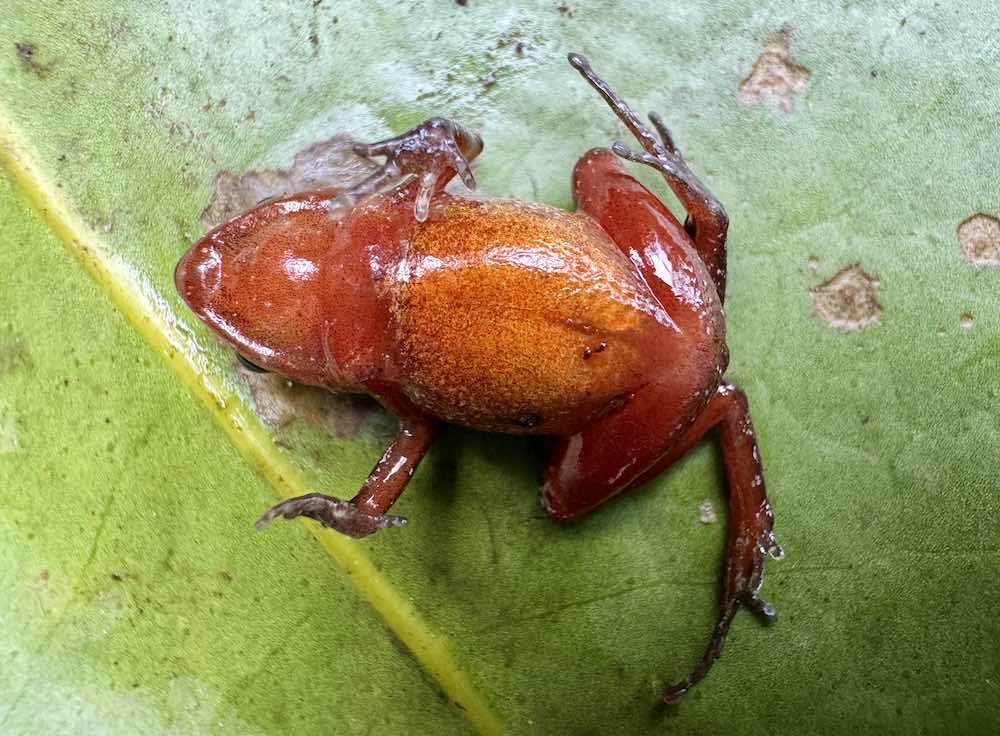 The Red-bellied Squeaker Frog (Arthroleptis hematogaster) had not been seen since the 1950s – Credit: Eli Greenbaum / The University of Texas at El Paso The herpetology team rediscovered the Red-bellied Squeaker Frog (Arthroleptis hematogaster) which had not been seen since the 1950s. This was Greenbaum’s eleventh expedition to the Democratic Republic of the Congo where he was inspired to write his book, Emerald Labyrinth: A Scientist’s Adventures in the Jungles of the Congo.The dean of the College of Science at UTEP hopes these groundbreaking discoveries will illuminate and inspire students and scientists worldwide. First Known Photos of ‘Lost Bird’ Not Seen in 2 Decades are Captured by University of Texas Scientists |
Australian Turtledove
 Australian turtledove (Geopelia humeralis) is native to Australia animal. Australian turtledove is protected by National Parks and Wildlife Act 1974. They include a pigeon-sized, their size varies between 26-30 cm (10.4 to 12 inches). They has distinctive and melodious voice that sounding like "cook-a-wook "or" coolicoo ". The Australian turtledoves are very graceful, with beautiful eyes circled in a strong orange color, in addition to sound good, they also having beautiful fur. Turtledove bird known for its uniqueness of his voice. Fans come from all walks of society. However, australian turtledoves are different, other than soft-spoken, their fur color is quite beautiful. So hobbyists interested to collecting, even want to get of their offspring of intercross result with other types. White speckled. The shape and size smaller than usual turtledove, and a gray body color. Her eyes circled in striking orange color, and feather wings decorated with the white spots a little rough, there are different with the African turtledove who having soft white spots. Other peculiarity of this turtledove is they has attractive appearance and soft-spoken, especially the male. Usually the male is always showing off his wing feathers in front of the female, to steal the attention of the female. The female will then approach him, then both attracted to each other. Particularity the nature and pattern of the soft fur color makes hobbyists interested to collecting this Australian turtledove. Recognize them. In the match of turtledove, you need to know and understand its properties. For example, the sound quality, the beauty of his feathers, and body shape. It is very important, if their mother are good quality, likely that his children would also be good turtledove. Moreover, if their parent is the champion turtledove, almost certainly the offspring can be the champion. Many hobbyists who tried to make intercross of gray Australian turtledove with bangkok and African turtledove. This effort is expected to generate turtledove feather color pattern and good sound..Source: The True Adventures |
Website can identify birds from photos

www.eurekalert.com: In a breakthrough for computer vision and for bird watching, researchers and bird enthusiasts have enabled computers to achieve a task that stumps most humans — identifying hundreds of bird species pictured in photos.
|