
 The first-ever photograph of Yellow-crested Helmetshrike (Prionops alberti) Credit: Matt Brady / The University of Texas at El Paso First Known Photos of ‘Lost Bird’ Not Seen in 2 Decades are Captured by University of Texas Scientists: For the first time, scientists have captured photos of a bird in Africa that was unseen for nearly twenty years. Known as the Yellow-crested Helmetshrike, the species had been listed as a ‘lost bird’ by the American Bird Conservancy because it had not been spotted in nearly two decades. Scientists from the University of Texas at El Paso discovered a small flock of the birds during a six-week expedition to a mountain range in eastern Democratic Republic of the Congo. “It was a mind-blowing experience to come across these birds. We knew they might be possible here, but I was not prepared for how spectacular and unique they would appear in life,” said UTEP assistant professor Michael Harvey, Ph.D, an ornithologist. Harvey co-led the expedition with UTEP Professor Eli Greenbaum, Ph.D. They were joined by ornithologist Matt Brady, as well as a group of Congolese researchers from the Centre de Recherche en Sciences Naturelles. The team trekked on foot for 75 miles through the depths of the Itombwe Massif mountains, studying birds, amphibians, and reptiles along the way. While exploring the cloud forests on the slopes of a mountain, Harvey and Brady stumbled upon the helmetshrike—a striking black bird with a bright yellow “helmet.” In total, about 18 helmetshrikes appeared in noisy and active groups among the mid-layer of forest vegetation at three sites, during the expedition. The bird is endemic to the western slopes of the Albertine Rift of Central Africa, according to Harvey, a region that has been largely inaccessible due to war and security issues, but which has recently become safer to visit. “This inspires hope that perhaps the species still has a reasonably healthy population in the remote forests of the region,” Harvey said. With mining, logging, and agriculture making inroads deep into the forests of the Itombwe range, the team is in discussions with other researchers and conservation organizations to launch efforts to protect the helmetshrikes. “Right now is a golden opportunity to protect these tropical forests, so that we don’t lose species like the helmetshrike before they are known and studied,” said Harvey. The expedition, which ran from December 2023 to January 2024, yielded other important discoveries. 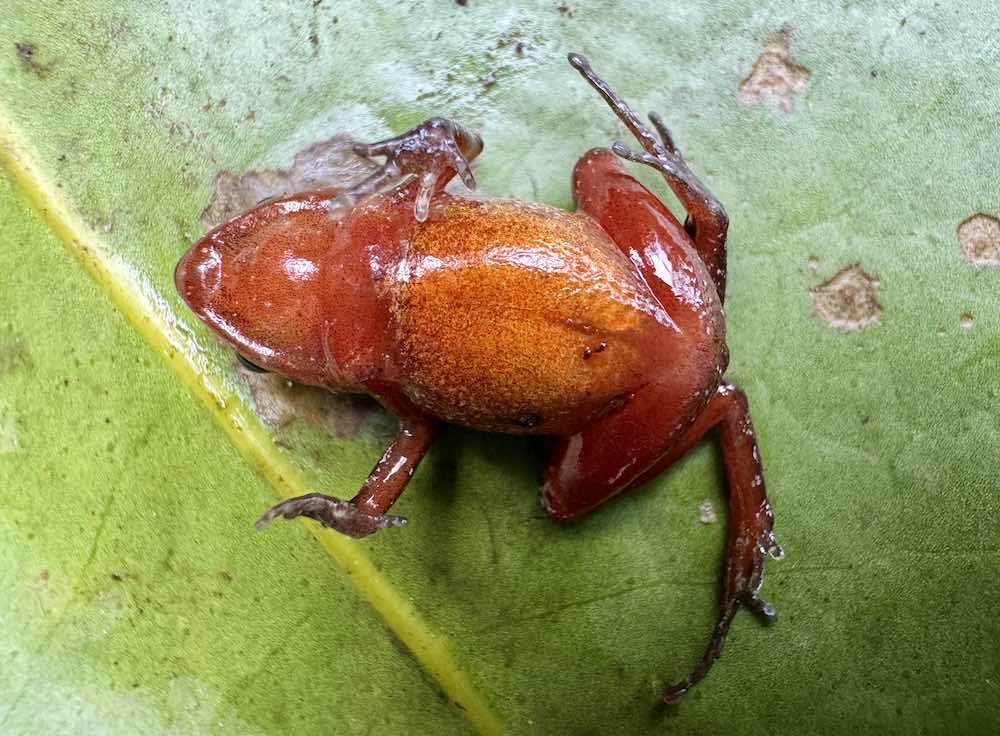 The Red-bellied Squeaker Frog (Arthroleptis hematogaster) had not been seen since the 1950s – Credit: Eli Greenbaum / The University of Texas at El Paso The herpetology team rediscovered the Red-bellied Squeaker Frog (Arthroleptis hematogaster) which had not been seen since the 1950s. This was Greenbaum’s eleventh expedition to the Democratic Republic of the Congo where he was inspired to write his book, Emerald Labyrinth: A Scientist’s Adventures in the Jungles of the Congo.The dean of the College of Science at UTEP hopes these groundbreaking discoveries will illuminate and inspire students and scientists worldwide. First Known Photos of ‘Lost Bird’ Not Seen in 2 Decades are Captured by University of Texas Scientists |
Savannah - The Tallest Cat in the World
 The Savannah Cat, Scarlett’s Magic is the Guinness record holder for the world’s tallest cats  Owner Miss Kim Droper describes her cat as an obedient and smart one. She also said that the Savannahs are the most beautiful companion for the family. She adds that they are active cats and like to play with family members. She owns the Californian-based Savannah Cat Shoppe, with her husband Lee. This Savannah breed is popular in California because of their beautiful appearances and their great learning abilities.          |


Black Cats in Illustrations by Kamwei Fong
 Using only black ink, Malaysian illustrator Kamwei Fong has created a menagerie of playful black cats. The artist builds each feline form using innumerable short thin lines, varying the density of the marks to create volume as well as a palpable sense of furriness. Fong has been working as an illustrator since 2010, under the moniker Bo & Friends, and in addition to his cat character, which he calls The Furry Thing, he dreams up similarly charming monkeys, goldfish, puppies, and other animals in his line-driven black ink drawings. You can see more of his work on Instagram and Facebook.       |
Ani-Human Series by Lennette Newell
  Lennette Newell was born in the high plains of Kimball, Nebraska. Daughter to a large animal veterinarian, her fascination with animal behavior sparked at a young age amidst a ranch equipped with a large animal hospital. Due to her father’s profession, she began to learn the scientific ideas behind various animal mannerisms. Though as a child she also observed many other characteristics mirrored in herself, leading her to see the animals as something beyond a patient to be treated. Her curiosity with animals was augmented by her captivation with the entire natural world, from the plants growing in her yearly garden to the dramatic cloud formations penetrated by diverse sunlight patterns. Mesmerized by her environment, Lennette chose to use the art of photography to capture these enthralling aspects of life. Beginning as a commercial photographer, she specialized in advertisements containing human and animals. Simultaneously she maintained a passion to pursue fine art, constantly photographing humans and animals in original styles to reveal the beautiful personalities of living creatures. Her work has been recognized for many photographic prizes, including the International Photography Awards 1st in Pets and the Graphics Photography Annual Gold & Silver Winner in 2014, and shown in several exhibitions, for example, Leo Burnett in London, LA Art Fair, Municipal Heritage Museum, Malaga and The Fair Art Show in New York etc. Acclaim for her Ani-human series has inspired her to continue expressing the exquisiteness of animal characters in a hope to make others aware of what we might be losing if environmental destruction continues. For more about her work visit her website www.lennettenewell.com.        |
Australian Turtledove
 Australian turtledove (Geopelia humeralis) is native to Australia animal. Australian turtledove is protected by National Parks and Wildlife Act 1974. They include a pigeon-sized, their size varies between 26-30 cm (10.4 to 12 inches). They has distinctive and melodious voice that sounding like "cook-a-wook "or" coolicoo ". The Australian turtledoves are very graceful, with beautiful eyes circled in a strong orange color, in addition to sound good, they also having beautiful fur. Turtledove bird known for its uniqueness of his voice. Fans come from all walks of society. However, australian turtledoves are different, other than soft-spoken, their fur color is quite beautiful. So hobbyists interested to collecting, even want to get of their offspring of intercross result with other types. White speckled. The shape and size smaller than usual turtledove, and a gray body color. Her eyes circled in striking orange color, and feather wings decorated with the white spots a little rough, there are different with the African turtledove who having soft white spots. Other peculiarity of this turtledove is they has attractive appearance and soft-spoken, especially the male. Usually the male is always showing off his wing feathers in front of the female, to steal the attention of the female. The female will then approach him, then both attracted to each other. Particularity the nature and pattern of the soft fur color makes hobbyists interested to collecting this Australian turtledove. Recognize them. In the match of turtledove, you need to know and understand its properties. For example, the sound quality, the beauty of his feathers, and body shape. It is very important, if their mother are good quality, likely that his children would also be good turtledove. Moreover, if their parent is the champion turtledove, almost certainly the offspring can be the champion. Many hobbyists who tried to make intercross of gray Australian turtledove with bangkok and African turtledove. This effort is expected to generate turtledove feather color pattern and good sound..Source: The True Adventures |
Flora Borsi - Animeyed
 In New collection of self-portraits Flora Borsi creates a hybrid of humans and animals, matching her hairstyle, makeup, and eye color to the characteristics of each animal hiding one part of her face. For more of her works visit www.floraborsi.com.      |
Cute Finger Monkeys
 You might be wondering what in the world is a finger monkey! In fact, its name itself gives it away! First, a finger monkey is a primate. Second, it gets the first part of its name due to it being finger size in length! If you haven’t seen it - well, you’ll have to just believe me! This cute little primate hugs and grips on to your finger so tight that it pulls your heartstrings and you wish you could take it home with you. Finger monkeys are, as a matter of fact, pygmy marmosets. They are also known by the names ‘Pocket Monkey’ and ‘Tiny Lion’. These primates belong to the family Callitrichidae, species Cebuella and genus C. pygmaea. They are native to rain-forests of Brazil, Peru, Bolivia, Ecuador and Colombia.            |